
Bitumen is a complex mixture of high molecular weight hydrocarbon and non-hydrocarbon molecules. This material has several applications in road pavement, roofing, flooring, etc. It is important to know the bitumen types and grades to choose the best bitumen for specific application. In this essay, we are going to read about sources, different types, and grades of bitumen.
What is the source of bitumen?
Based on the source, bitumen has two types:
Natural bitumen is extracted from mine (Gilsonite) or natural lake.
Refinery bitumen: Refinery bitumen is derived from crude oil. This type of bitumen is common in different industries.
If you are interested in learn more about Gilsonite, read our article here.
What Are Different Bitumen Types and Grades?
Bitumen has different types and grades. Each type of bitumen is suitable for various applications. Understanding these types and how they are graded helps to make a good decision on selecting bitumen for project.
In the following, we are going to introduce:
Penetration grade bitumen
Viscosity grade bitumen
Performance grade bitumen
Oxidized bitumen
Bitumen emulsion
Polymer-modified bitumen
Penetration Grade Bitumen
Penetration grade bitumen is a type of bitumen that is commonly used in road construction.
Penetration grade bitumen is specified by two factors: penetration and softening point.
Penetration is obtained in penetration test. This test shows the bitumen consistency. In this test, a standard 100g needle is placed vertically on the bitumen for 5 seconds at 25°C. The depth of penetration of the needle in bitumen is reported as penetration depth in deci-millimeter (0.1 mm) unit. Higher penetration depth means softer bitumen. For example, a bitumen with 100 penetration depth is softer than bitumen with 50 penetration depth.
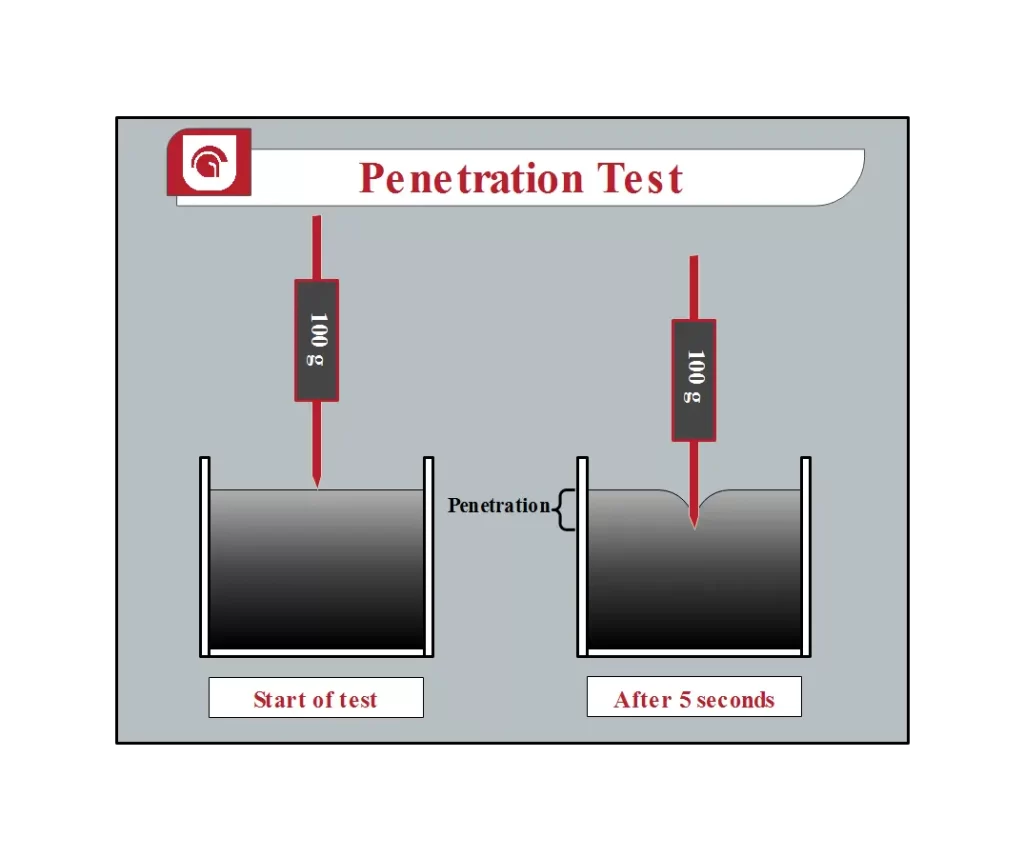
Based on this penetration depth, bitumen has different grades. Grades are named using two numbers: the first number is minimum penetration and the second is maximum penetration depth for a bitumen in this grade.
Common grades are:
20/30, 30/45, 35/50, 40/60, 50/70, 70/100, 100/150, 160/220, and 250/330.
For example, in grade 50/70, the penetration depth is between 50 and 70 deci-millimeters.
The softening point (related to bitumen consistency by increasing temperature) is also considered in this grading.
This grading system helps to select the right bitumen for specific road construction needs.
Viscosity Grade Bitumen (VG)
Viscosity grade bitumen includes types of bitumen that are graded based on viscosity. Viscosity indicates how a fluid resists flow.
This grading system considers the viscosity of bitumen at 60°C and 135°C.
According to the viscosity, there are four different grades of VG bitumen:
VG-10, VG-20, VG-30, and VG-40.
A higher grade number means the bitumen is more viscous and flow harder.
Performance Grade Bitumen (PG)
Performance Grade Bitumen is a type of bitumen that is graded based on how bitumen performs in different temperatures. This grading system helps engineers to find the best bitumen for the climate condition.
Different grade of performance grade bitumen is determined by two numbers. These numbers show the range of temperatures in which the bitumen can be performed.
The first number is the maximum temperature in degrees Celsius during one week in the environment. The second number (is negative) indicates the minimum temperature in degrees Celsius.
For example, PG 52-22 is designed to be used in an environment with an average 7-day maximum temperature of 52 and a minimum pavement design temperature of -22.
Common grades of PG bitumen are:
PG 46-34, PG 46-40, PG 46-46
PG 52-10, PG 52-16, PG 52-22, PG 52-28, PG 52-34
PG 58-16, PG 58-22, PG 58-28,
PG 64-10, PG 64-16, PG 64-22, PG 62-28
PG 70-10, PG-70-16, PG 70-22
PG 76-10, PG 76-16, PG 76-22, PG 76-28
PG 82-10
Oxidized Bitumen (Blown bitumen)
Oxidized bitumen or blown bitumen is commonly used in flooring, roofing, and pipe coating.
Oxidized bitumen is obtained by blowing hot air (200-270 °C) into bitumen. This process changes the chemical structure of molecules and increases the overall molecular size of asphaltene.
Oxidized bitumen has lower penetration and higher softening points compared to regular bitumen. Therefore, it is a suitable choice for roofing which needs durable bitumen.
Oxidized bitumen is graded based on the penetration and softening point.
The first number indicates the softening point at °C and the second number is penetration depth at 25°C. For example, 85/25 is an oxidized bitumen with an 85°C softening point and 25 dmm penetration depth.
According to this grading system, there are many grades:
75/30, 85/25, 85/40, 95/25,105/35, and 115/15.
Bitumen emulsion
Bitumen emulsion is a type of bitumen made by combining bitumen, water, and an emulsifying agent. It has lower viscosity at normal temperatures and is a good choice for cold pavement mixtures.
When an emulsifying agent is added to the water and bitumen, it makes a bridge between water and bitumen and makes a stable emulsion. In this process, each bitumen droplet gets coated with an emulsifier and takes the electric charge of it.
Based on the electrical charge of the emulsifier, there are three types of bitumen emulsion:
In addition, according to setting time, the bitumen emulsion has three classifications:
- Slow setting (SS)
- Medium setting (MS)
- Rapid setting (RS).
In the following table, you can see bitumen emulsion grades.